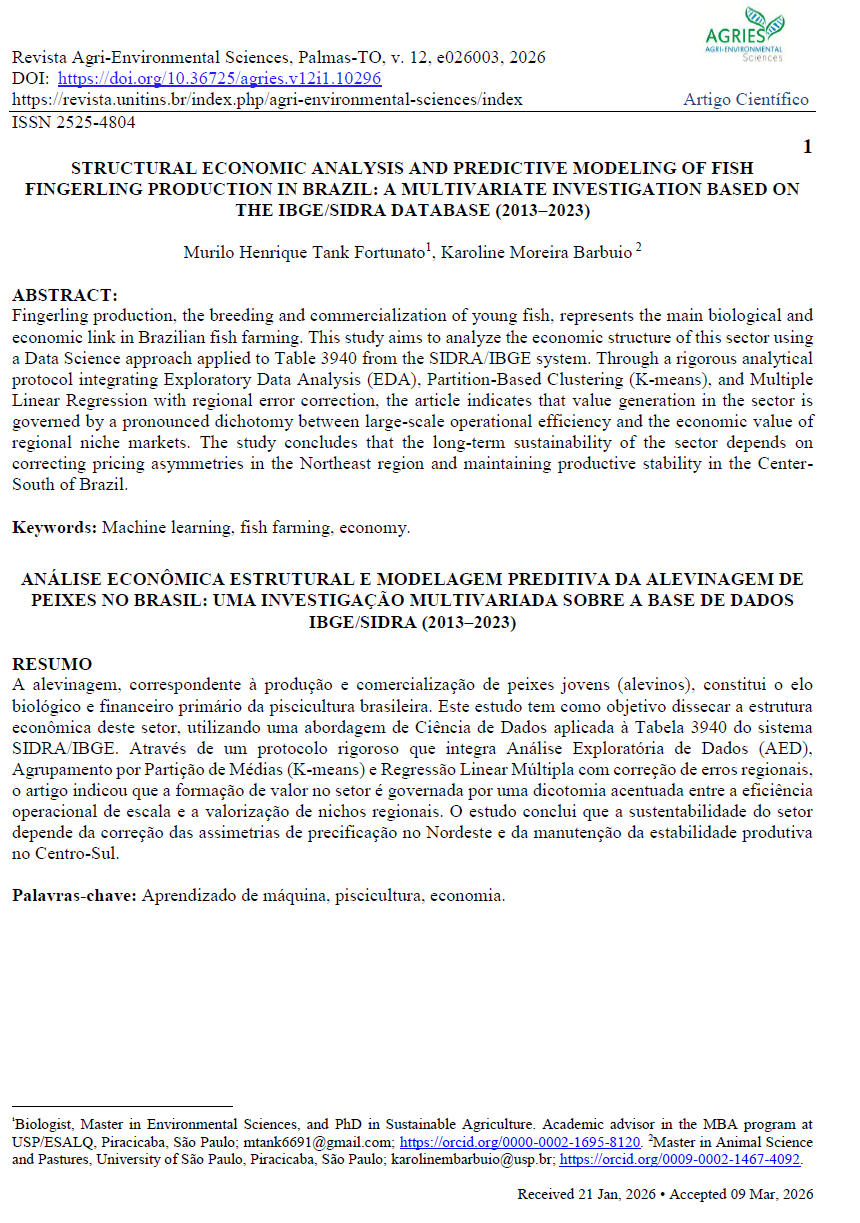
STRUCTURAL ECONOMIC ANALYSIS AND PREDICTIVE MODELING OF FISH FINGERLING PRODUCTION IN BRAZIL: A MULTIVARIATE INVESTIGATION BASED ON THE IBGE/SIDRA DATABASE (2013–2023)
Resumen
Fingerling production, the breeding and commercialization of young fish, constitutes the primary biological and financial link in Brazilian fish farming. This study aims to dissect the economic structure of this sector using a Data Science approach applied to Table 3940 from the SIDRA/IBGE system. Through a rigorous analytical protocol integrating Exploratory Data Analysis (EDA), Partition-Based Clustering (K-means), and Multiple Linear Regression with regional error correction, the article demonstrates that value formation in the sector is governed by a pronounced dichotomy between large-scale operational efficiency and the economic valuation of regional niche markets. The study concludes that the long-term sustainability of the sector depends on correcting pricing asymmetries in the Northeast region and maintaining productive stability in the Center-South of Brazil.
Derechos de autor 2026 AGRI-ENVIRONMENTAL SCIENCES

Esta obra está bajo licencia internacional Creative Commons Reconocimiento-NoComercial-SinObrasDerivadas 4.0.
Direitos autorais
Após a aceitação de um artigo, os autores serão convidados a preencher um formulário de " licença exclusiva” que permitirá a divulgação do artigo na forma de acesso aberto. Para podermos fazer o trabalho de publicação e divulgação do artigo de pesquisa precisamos dos direitos para publicação. Para artigos de acesso aberto, usamos um acordo exclusivo de licenciamento em que os autores mantêm os direitos autorais em/de seu artigo.
Neste acordo os autores mantêm direitos sobre:
-Patentes e outros direitos de propriedade intelectual no artigo
-O direito de crédito para o trabalho publicado
Política de Acesso
Os artigos pulicados nesta revista são de acesso aberto, devem ser compartilhados livremente desde que a fonte e seus autores sejam citados de maneira adequada, visando à preservação dos direitos autorais e propriedade intelectual. Os trabalhos publicados na revista serão simultaneamente licenciados sob a Creative Commons Attribution License (CC BY-NC-ND), permitindo o compartilhamento do artigo com reconhecimento da autoria do trabalho e da publicação inicial nesta revista.