DESCRIPTIVE ANALYSIS OF CARP PRODUCTION (Cyprinus Carpio) IN BRAZIL: REGIONAL CONCENTRATION, VALUATION, AND LIMITS OF FORECASTING WITH SHORT TIME SERIES
Abstract
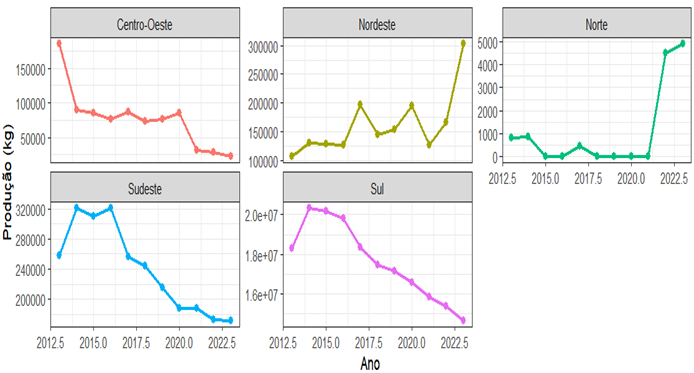
This study uses a 10-year time series (2013–2023) to analyze the dynamics of carp (Cyprinus carpio) production and valuation in Brazil. Data processing revealed a strong production concentration in the Southern Region (over 95% of total volume), indicating a pattern of regional specialization associated with potential mechanisms of structural dependence (path dependence). The price series (R$/kg) exhibited non-stationary behavior and an upward trend, suggesting the influence of production costs and the role of higher value-added niche markets. Predictive modeling, based on ARIMA ($p, d, q$) and ETS models, was employed in an exploratory manner. Although the ARIMA model showed lower forecast error (RMSE: 818,393.5 kg) compared to ETS, the results should be interpreted with caution due to the limited length of the time series. The projections displayed an approximately constant pattern, which is consistent with informational constraints typical of short annual series, and therefore do not provide robust evidence of structural stagnation or sector maturity. The findings highlight the relevance of regional production concentration, the dynamics of economic valorization, and the need to expand and integrate data sources to support more robust predictive analyses. From a strategic perspective, opportunities are identified in value addition, production diversification, and the strengthening of specific niches, such as the ornamental carp (Koi) market.
Copyright (c) 2026 AGRI-ENVIRONMENTAL SCIENCES

This work is licensed under a Creative Commons Attribution-NonCommercial-NoDerivatives 4.0 International License.
Copyright
Upon acceptance of a manuscript, authors will be asked to complete an "exclusive license" form that will allow the manuscript to be disclosed in the form of open access. In order to do the work of publishing and disseminating the research paper manuscript we need the rights to publish. For open access manuscripts, we use an exclusive licensing agreement where authors retain copyright from their manuscript.
In this agreement the authors retain rights to:
-Patents and other intellectual property rights in manuscript
-The right to credit for published work