INITIAL TOLERANCE OF THE IACSP95-5000 CULTIVAR: II - POST-PLANTING HERBICIDES UNDER DIFFERENT PLANTING TECHNOLOGIES
DOI:
https://doi.org/10.36725/agries.v12i2.11594Keywords:
Chemical control, phytotoxicity, pre-sprouted seedlings, Saccharum spp, selectivityAbstract
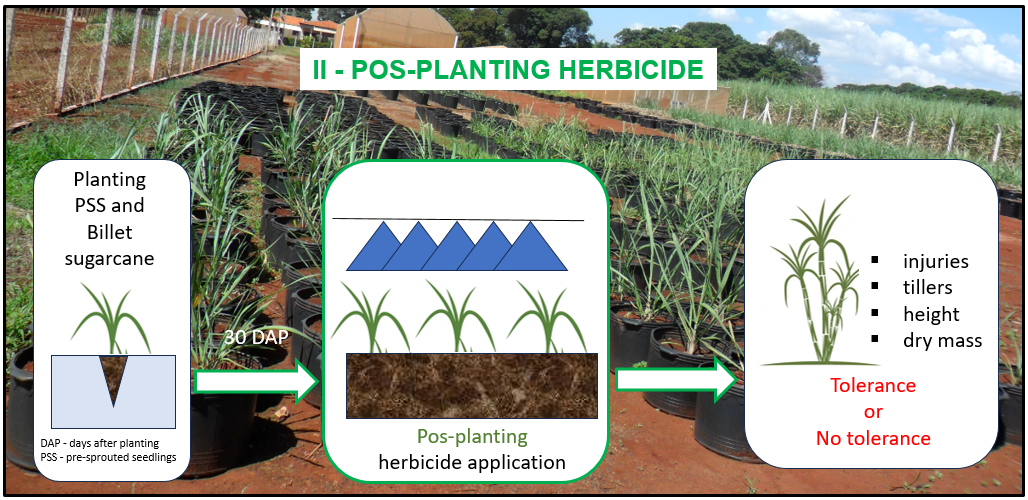
Sugarcane planting systems are based on conventional billet planting and the use of pre-sprouted seedlings (PSS), which may influence herbicide selectivity. This study aimed to evaluate the initial tolerance of the sugarcane cultivar ‘IACSP95-5000’ under billet planting and different PSS systems to herbicides applied after planting. The experiment was conducted in a randomized block design in a factorial arrangement with four replications. Factor A consisted of planting technologies (billet, MPB IAC, Plene® PB, and Plene® Envolve), and factor B consisted of herbicides (ametryn; isoxaflutole; ametryn + isoxaflutole; ametryn + clomazone; isoxaflutole + clomazone; ametryn + trifloxysulfuron-sodium; and a control treatment). Herbicides were applied 20 days after planting. Phytotoxicity symptoms were evaluated at 60, 90, and 120 days after application, while tillering and plant height were assessed at 60 and 120 days, and dry mass at 120 days. At the early stage of seedling development, all herbicide treatments caused phytotoxicity; however, symptoms decreased over time as plants developed, a trend also observed for tillering and plant height. Isoxaflutole and the ametryn + clomazone mixture were not selective for the initial development of the sugarcane cultivar ‘IACSP95-5000’ under the evaluated planting technologies (billet, MPB IAC, Plene® PB, and Plene® Envolve) when applied after planting.
Downloads
Published
Issue
Section
License
Copyright
Upon acceptance of a manuscript, authors will be asked to complete an "exclusive license" form that will allow the manuscript to be disclosed in the form of open access. In order to do the work of publishing and disseminating the research paper manuscript we need the rights to publish. For open access manuscripts, we use an exclusive licensing agreement where authors retain copyright from their manuscript.
In this agreement the authors retain rights to:
-Patents and other intellectual property rights in manuscript
-The right to credit for published work