PHYSICOCHEMICAL CHARACTERIZATION OF GUAVA (Psidium guajava) PULP SUBJECTED TO THE FOAM-MAT DRYING PROCESS
DOI:
https://doi.org/10.36725/agries.v12i2.11561Keywords:
mathematical modeling, emulsifier, phenolic compoundsAbstract
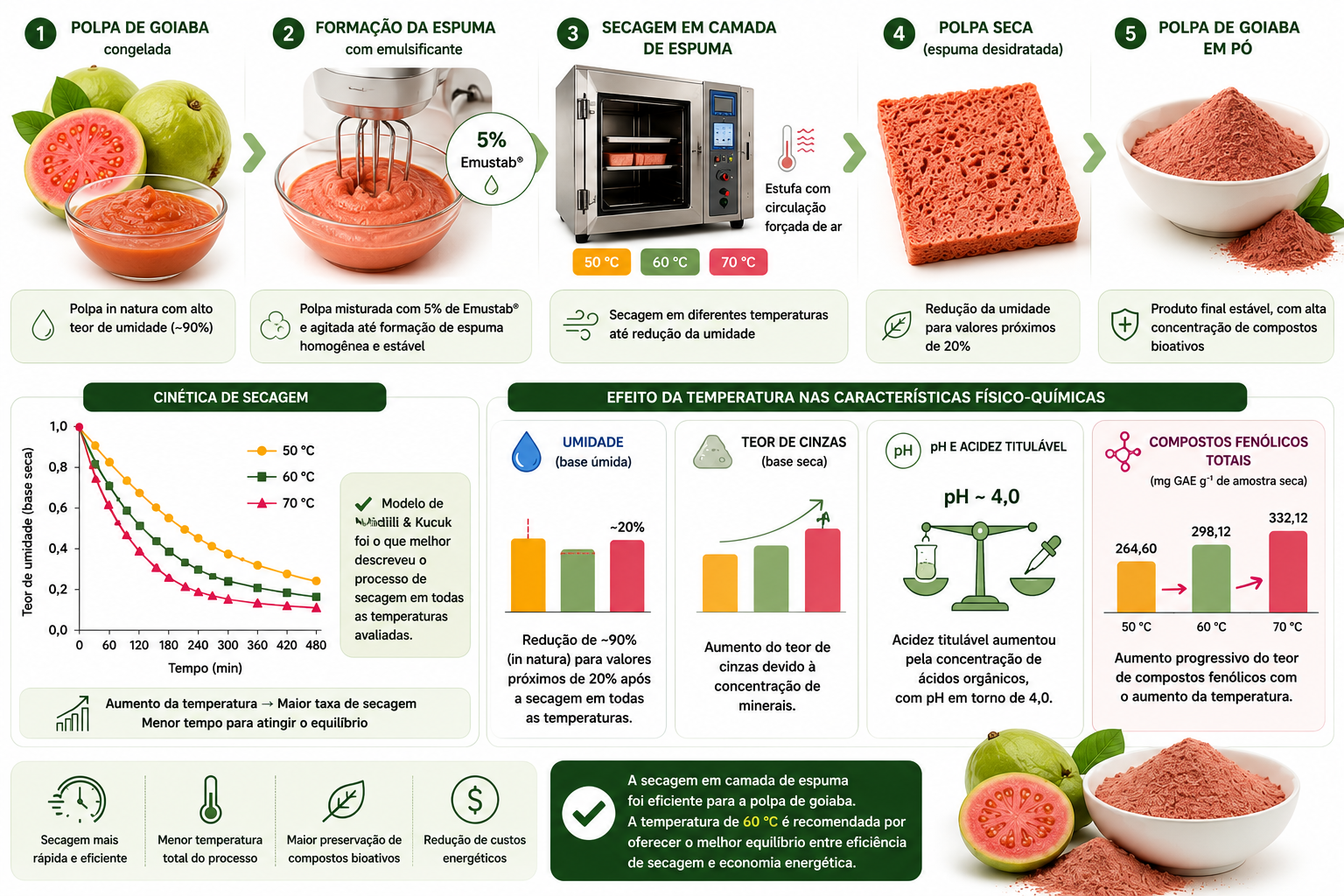
This study aimed to evaluate the drying kinetics of guava pulp (Psidium guajava) and the influence of temperature on its physicochemical characteristics using the foam-mat drying method. Frozen guava pulp was mixed with 5% Emustab® emulsifier and whipped until a homogeneous foam was formed. Drying curves were obtained in a forced-air circulation oven at temperatures of 50, 60, and 70 °C. The experimental data were fitted using the semi-empirical models of Henderson and Pabis, Page, and Midilli & Kucuk, with the latter providing the best fit at all evaluated temperatures. Physicochemical analyses included pH, moisture content, ash content, and total phenolic compounds. The moisture content of the fresh pulp, initially around 90%, was reduced to values close to 20% after drying, regardless of the temperature applied. Ash content increased, indicating mineral concentration, while total titratable acidity increased due to the concentration of organic acids, with pH remaining around 4.0. An increase in the total phenolic compound content was observed with increasing temperature, ranging from 264.60 mg g-1 at 50 °C to 332.12 mg g-1 at 70 °C. This behavior can be attributed to the effect of temperature on the disruption of cell walls and the solubilization of phenolic compounds bound to the plant matrix, thereby facilitating their release into the extraction medium. It is concluded that foam-mat drying was efficient, with 60 °C recommended as the optimal drying temperature due to the balance between drying efficiency and energy savings.
Downloads
Published
Issue
Section
License
Copyright
Upon acceptance of a manuscript, authors will be asked to complete an "exclusive license" form that will allow the manuscript to be disclosed in the form of open access. In order to do the work of publishing and disseminating the research paper manuscript we need the rights to publish. For open access manuscripts, we use an exclusive licensing agreement where authors retain copyright from their manuscript.
In this agreement the authors retain rights to:
-Patents and other intellectual property rights in manuscript
-The right to credit for published work