
TOLERANCE OF 'CTC4' SUGARCANE PRE-SPROUTED SEEDLINGS TO POST-TRANSPLANT HERBICIDES
DOI:
https://doi.org/10.36725/agries.v12i2.11509Keywords:
Phytotoxicity, Saccharum spp, selectivityAbstract
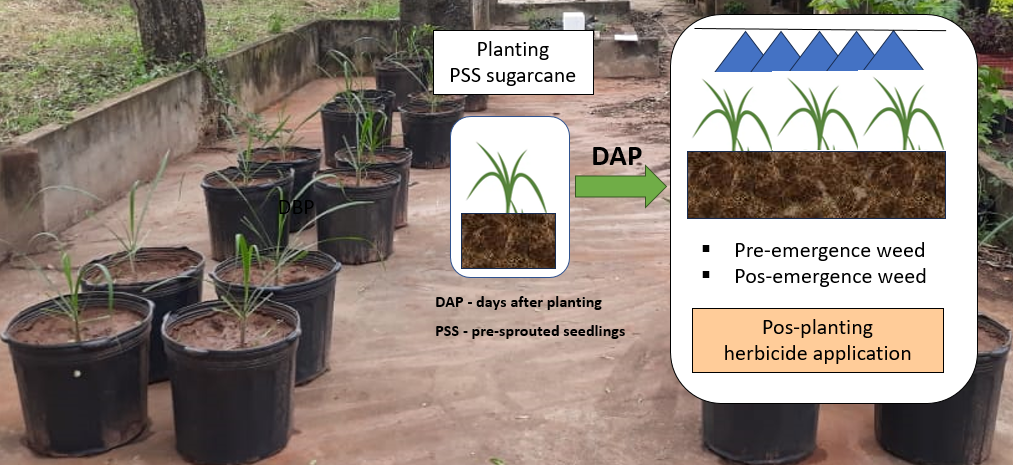
The sugarcane and ethanol industry has increasingly adopted pre-sprouted seedlings (PSS) for crop establishment, making chemical weed control a critical management practice during early development. This study aimed to evaluate the tolerance of the sugarcane cultivar CTC4 to five herbicide treatments: clomazone, sulfentrazone, tebuthiuron, clomazone + sulfentrazone, and sulfentrazone + tebuthiuron, compared against an untreated control. The experiment was conducted in pots using a completely randomized design with four replicates. Herbicide treatments were applied post-transplanting of the PSS. Phytotoxicity symptoms, tiller number, and plant height were evaluated at distinct intervals. While sulfentrazone and sulfentrazone + tebuthiuron induced initial phytotoxicity in the cultivar, these symptoms completely subsided by 90 days after application (DAA). A temporary reduction in height was observed at 30 DAA with the sulfentrazone treatment; however, plants recovered in subsequent evaluations, and tiller emission was unaffected. It is concluded that CTC4 sugarcane pre-sprouted seedlings exhibit adequate tolerance to the tested herbicides, demonstrating successful recovery from early transient injury.
Downloads
Published
Issue
Section
License
Copyright
Upon acceptance of a manuscript, authors will be asked to complete an "exclusive license" form that will allow the manuscript to be disclosed in the form of open access. In order to do the work of publishing and disseminating the research paper manuscript we need the rights to publish. For open access manuscripts, we use an exclusive licensing agreement where authors retain copyright from their manuscript.
In this agreement the authors retain rights to:
-Patents and other intellectual property rights in manuscript
-The right to credit for published work






