COSTS AND PRODUCTIVE PERFORMANCE WITH SUPPLEMENTATION STRATEGIES FOR HEIFERS DURING THE RAINY-TO-DRY TRANSITION PERIOD
DOI:
https://doi.org/10.36725/agries.v11i2.10830Keywords:
Economic aspects, cattle farming, productionAbstract
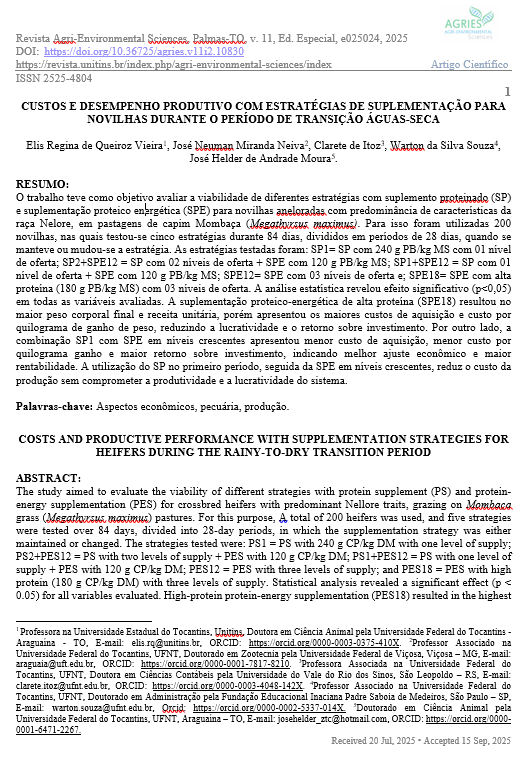
The study aimed to evaluate the viability of different strategies with protein supplement (PS) and protein energy supplementation (PES) for crossbred heifers with predominant Nellore traits, grazing on Mombaça
grass (Megathyrsus maximus) pastures. For this purpose, A total of 200 heifers was used, and five strategies
were tested over 84 days, divided into 28-day periods, in which the supplementation strategy was either
maintained or changed. The strategies tested were: PS1 = PS with 240 g CP/kg DM with one level of supply;
PS2+PES12 = PS with two levels of supply + PES with 120 g CP/kg DM; PS1+PES12 = PS with one level of
supply + PES with 120 g CP/kg DM; PES12 = PES with three levels of supply; and PES18 = PES with high
protein (180 g CP/kg DM) with three levels of supply. Statistical analysis revealed a significant effect (p <
0.05) for all variables evaluated. High-protein protein-energy supplementation (PES18) resulted in the highest final body weight and unit revenue but showed the highest acquisition costs and cost per kilogram of weight
gain, thereby reducing profitability and return on investment. On the other hand, the combination of PS1 with PES at increasing levels presented lower acquisition costs, lower cost per kilogram gained, and higher return on investment, indicating better economic adjustment and greater profitability. The use of PS in the first period, followed by PES at increasing levels, reduces production costs without compromising the productivity and profitability of the system.
Downloads
Published
Issue
Section
License
Copyright
Upon acceptance of a manuscript, authors will be asked to complete an "exclusive license" form that will allow the manuscript to be disclosed in the form of open access. In order to do the work of publishing and disseminating the research paper manuscript we need the rights to publish. For open access manuscripts, we use an exclusive licensing agreement where authors retain copyright from their manuscript.
In this agreement the authors retain rights to:
-Patents and other intellectual property rights in manuscript
-The right to credit for published work