
WATER QUALITY AND PERFORMANCE OF TAMBAQUI IN PRODUCTION INTEGRATED TO THE CULTIVATION OF FORAGE GRASS AND PEANUTS
DOI:
https://doi.org/10.36725/agries.v10i1.8730Keywords:
Aquaponic, Arachis pintoi, Colossoma macropomum, Hemarthria altíssimaAbstract
This study aimed to evaluate the water quality and the performance of tambaqui (Colossoma macropomum)
produced in a recirculating aquaculture system, integrated with Floralta grass (Hemarthria altissima) and
forage peanut (Arachis pintoi) cultivation. The experiment was conducted from July to October 2017 in a
completely randomized design with four treatments and four replications, resulting in a total of 16
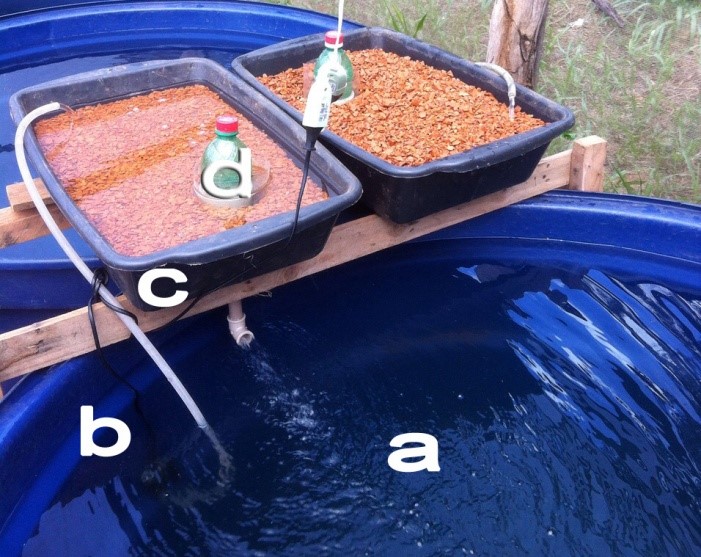
experimental units. Each experimental unit consisted of a 1 m³ pond connected to a 0.2 m² hydroponic system. The treatments comprised systems wherein the hydroponic unit was utilized to cultivate Floralta grass, forage peanut, a combination of both, and a control comprising solely the water recirculation system and no plants. The juvenile tambaqui were stocked at a density of 25 fish per cubic meter, which equates to a biomass of 0.1 kilograms per cubic meter. Performance parameters, including average weight, weight gain, feed intake, and feed conversion ratio, were evaluated, along with water quality variables such as pH, temperature, conductivity, alkalinity, dissolved oxygen, and total ammonia. The data were subjected to analysis of variance, and the means were compared using Tukey's test at a significance level of 5%. There was no significant difference for the evaluated animal performance data (p > 0.05). There were variations in water quality parameters as a function of the morning and afternoon periods, and these were observed throughout the growing months, but no differences were observed between treatments (p > 0.05). No significant differences in fish performance were observed among the treatments (p > 0.05). The water quality parameters demonstrated fluctuations between the morning and afternoon, as well as across the months of cultivation. However, no notable differences were observed between the treatments (p > 0.05). In summary, the stocking density of 25 fish per m³ in ponds integrated with a hydroponic system (0.2 m²) for the cultivation of Floralta grass, forage peanut, or a combination of both, resulted in similar performance outcomes for the tambaqui compared to those observed in a closed recirculating system without plants.
Downloads
Published
Issue
Section
License
Copyright
Upon acceptance of a manuscript, authors will be asked to complete an "exclusive license" form that will allow the manuscript to be disclosed in the form of open access. In order to do the work of publishing and disseminating the research paper manuscript we need the rights to publish. For open access manuscripts, we use an exclusive licensing agreement where authors retain copyright from their manuscript.
In this agreement the authors retain rights to:
-Patents and other intellectual property rights in manuscript
-The right to credit for published work






