
PERFORMANCE OF SUBSTRATES IN THE QUALITY OF SOUR PASSION FRUIT SEEDLINGS (Passiflora edulis Sims)
DOI:
https://doi.org/10.36725/agries.v12i2.11497Keywords:
Germination, seedling production, organic substrates, agricultural sustainabilityAbstract
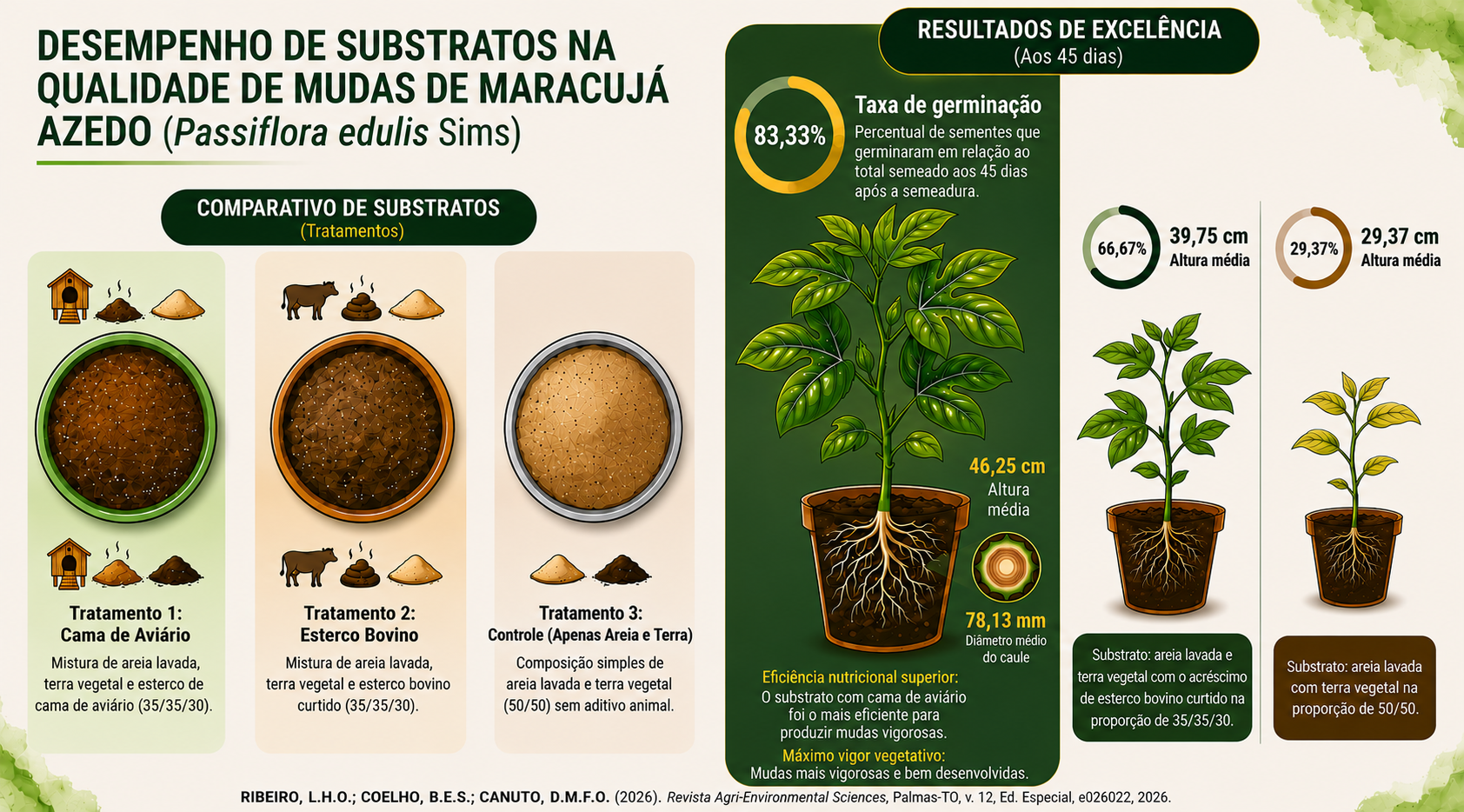
This study evaluated the influence of different substrate compositions on the growth and development of sour passion fruit seedlings (Passiflora edulis Sims). The experiment was conducted using a completely randomized design with three treatments and three replicates. Data were subjected to analysis of variance (ANOVA), and means were compared using Tukey’s test (p < 0.05). The tested substrate mixtures (by volume) were: (1) washed sand, topsoil, and cured poultry manure (35:35:30); (2) washed sand, topsoil, and cured cattle manure (35:35:30); and (3) washed sand and topsoil (50:50). Passion fruit seeds were sown in polyethylene tubes and irrigated twice daily. Parameters evaluated included germination rate at 15 days, alongside seedling morphological traits at 30 and 45 days after germination, including plant height, stem diameter, leaf number, and canopy diameter. The results revealed that the substrate containing poultry manure yielded the highest germination rate (83.33%) and the best morphological development, reaching an average height of 46.25 cm and a canopy diameter of 78.13 mm at 45 days. The substrate with cattle manure showed intermediate performance, whereas the sand and topsoil mixture produced the poorest growth, likely due to lower nutrient retention and suboptimal pH. In conclusion, substrates enriched with organic matter, particularly cured poultry manure, are highly effective for producing vigorous, high-quality sour passion fruit seedlings.
Downloads
Published
Issue
Section
License
Copyright
Upon acceptance of a manuscript, authors will be asked to complete an "exclusive license" form that will allow the manuscript to be disclosed in the form of open access. In order to do the work of publishing and disseminating the research paper manuscript we need the rights to publish. For open access manuscripts, we use an exclusive licensing agreement where authors retain copyright from their manuscript.
In this agreement the authors retain rights to:
-Patents and other intellectual property rights in manuscript
-The right to credit for published work






