EFECTO FISIOLÓGICO DEL REGULADOR DEL CRECIMIENTO VEGETAL 2,4-D EN HOJAS Y FRUTOS DE NARANJA DULCE AFECTADOS POR EL CANCRO DE LOS CÍTRICOS
DOI:
https://doi.org/10.36725/agries.v12i1.11401Palabras clave:
Abscission, Diameter of lesions, Peroxidase activity, Fruit detachment force, PhytopathologyResumen
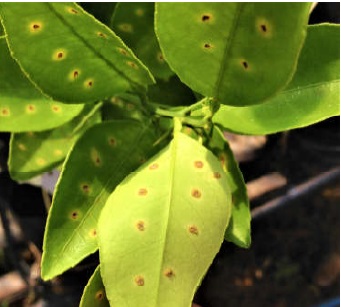
Citrus canker, caused by Xanthomonas citri subsp. citri (Xcc), is a highly destructive disease that significantly reduces both yield and fruit quality. The pathogen infects young leaf tissues, fruits, and shoots of susceptible citrus plants, often leading to severe defoliation and premature fruit drop. The herbicide 2,4-dichlorophenoxyacetic acid (2,4-D) is a synthetic auxin used at specific concentrations to mitigate citrus fruit drop. This study aimed to evaluate the in vitro effect of 2,4-D at various concentrations (0, 0.15, 0.30, 0.45, 0.60, and 0.75 mg i.a. L-1) on Xcc colonies, and to assess its impact on the lesion diameter of citrus canker on detached leaves of sweet orange (Citrus sinensis). Leaves were sampled 21 days after application (DAA) of 2,4-D at concentrations of 0, 0.20, 0.50, and 0.80 mg i.a. L-1. Additionally, the activity of soluble peroxidase was determined at 2, 7, and 14 DAA. Field trials were conducted to evaluate the development of citrus canker on leaves and the fruit detachment force required to remove fruit from the peduncle under the same concentration gradient. Results indicated that no 2,4-D concentration tested in vitro significantly affected Xcc colony-forming units (CFU). However, the mean lesion diameter on detached leaves and peroxidase activity decreased progressively with increasing concentrations of 2,4-D. While field observations showed a modest reduction in leaf lesion development, no significant impact was observed on the fruit detachment force. We conclude that although 2,4-D demonstrates potential in reducing the severity of citrus canker lesions, it does not significantly mitigate defoliation or fruit drop in field conditions at the tested concentrations.ncentrations.
Descargas
Publicado
Número
Sección
Licencia
Direitos autorais
Após a aceitação de um artigo, os autores serão convidados a preencher um formulário de " licença exclusiva” que permitirá a divulgação do artigo na forma de acesso aberto. Para podermos fazer o trabalho de publicação e divulgação do artigo de pesquisa precisamos dos direitos para publicação. Para artigos de acesso aberto, usamos um acordo exclusivo de licenciamento em que os autores mantêm os direitos autorais em/de seu artigo.
Neste acordo os autores mantêm direitos sobre:
-Patentes e outros direitos de propriedade intelectual no artigo
-O direito de crédito para o trabalho publicado
Política de Acesso
Os artigos pulicados nesta revista são de acesso aberto, devem ser compartilhados livremente desde que a fonte e seus autores sejam citados de maneira adequada, visando à preservação dos direitos autorais e propriedade intelectual. Os trabalhos publicados na revista serão simultaneamente licenciados sob a Creative Commons Attribution License (CC BY-NC-ND), permitindo o compartilhamento do artigo com reconhecimento da autoria do trabalho e da publicação inicial nesta revista.