
AGRONOMIC EFFICIENCY OF A MIXTURE OF ATRAZINE AND MESOTRIONE FOR THE CONTROL OF Sporobolus indicus IN MARANDU GRASS PASTURES
DOI:
https://doi.org/10.36725/agries.v12i3.12123Keywords:
weeds, herbicides, selectivity, pastureAbstract
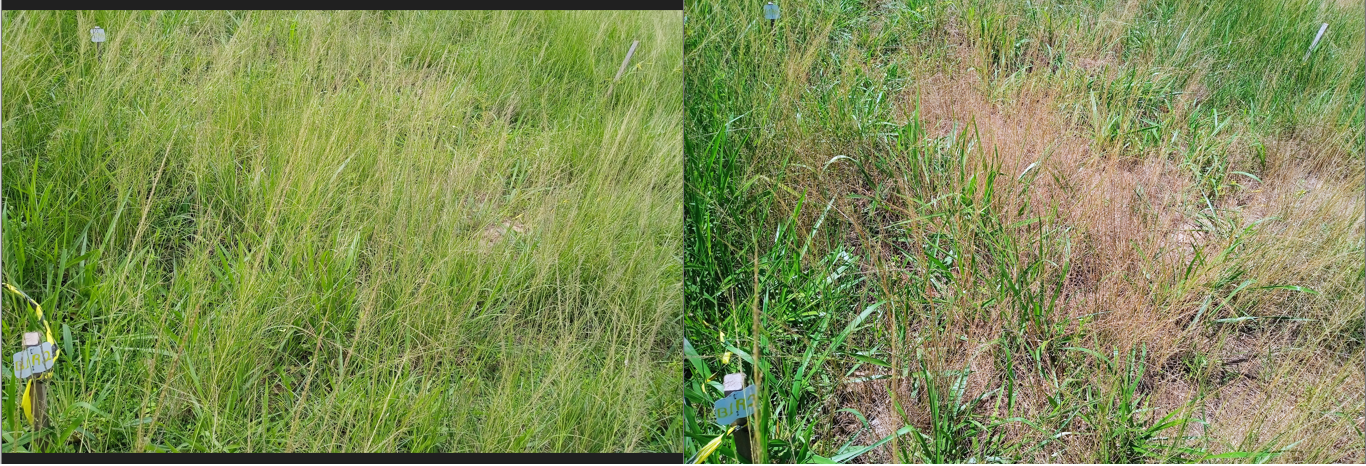
Smutgrass (Sporobolus indicus) is a difficult-to-control weed in pastures and can reduce forage productivity. This study aimed to evaluate the effect of mesotrione rates combined with atrazine on smutgrass control and selectivity to Marandu grass, as well as the effect of fertilization after herbicide application on the productive characteristics of the forage grass. The experiment was conducted on a rural property in the municipality of Eldorado dos Carajás, southeastern Pará, Brazil, using a randomized complete block design in a 4 × 2 factorial arrangement, with four replications. The first factor consisted of mesotrione rates (0, 3.3, 6.6, and 10% of the atrazine rate) combined with a fixed atrazine rate (3 L ha-1), whereas the second factor consisted of the presence or absence of fertilization (50 kg N ha-1 and 30 kg P ha-1) after herbicide application. At 100 days after application, smutgrass dry mass, smutgrass tussock density, total forage dry mass, Marandu grass tussock density, and tiller number were evaluated. No interaction was observed between mesotrione rates and fertilization conditions for the evaluated variables. Smutgrass dry mass decreased from 1,404.17 kg ha-1 in the absence of mesotrione to 0 kg ha-1 at the 10% rate, while smutgrass tussock density decreased from 13.13 to 0 tussocks m2 at the same rates. Marandu grass dry mass was higher at the 3.3% mesotrione rate, reaching 1,631.25 kg ha-1, compared with 985.50 kg ha-1 in the absence of the herbicide. Fertilization increased the number of Marandu grass tillers from 379.58 to 501.25 m2. Under the evaluated conditions, the 3.3% mesotrione rate combined with atrazine provided the best balance between smutgrass control efficiency and selectivity to Marandu grass.
Downloads
Published
Issue
Section
License
Copyright
Upon acceptance of a manuscript, authors will be asked to complete an "exclusive license" form that will allow the manuscript to be disclosed in the form of open access. In order to do the work of publishing and disseminating the research paper manuscript we need the rights to publish. For open access manuscripts, we use an exclusive licensing agreement where authors retain copyright from their manuscript.
In this agreement the authors retain rights to:
-Patents and other intellectual property rights in manuscript
-The right to credit for published work






