
ARTIFICIAL INTELLIGENCE IN ENVIRONMENTAL GOVERNANCE IN THE LEGAL AMAZON: A SOCIOTECHNICAL FRAMEWORK AND SAFEGUARDS FOR RESPONSIBLE USE
DOI:
https://doi.org/10.36725/agries.v12i3.11906Keywords:
algorithmic auditing, data governance, decision-making, environmental protection, institutional accountabilityAbstract
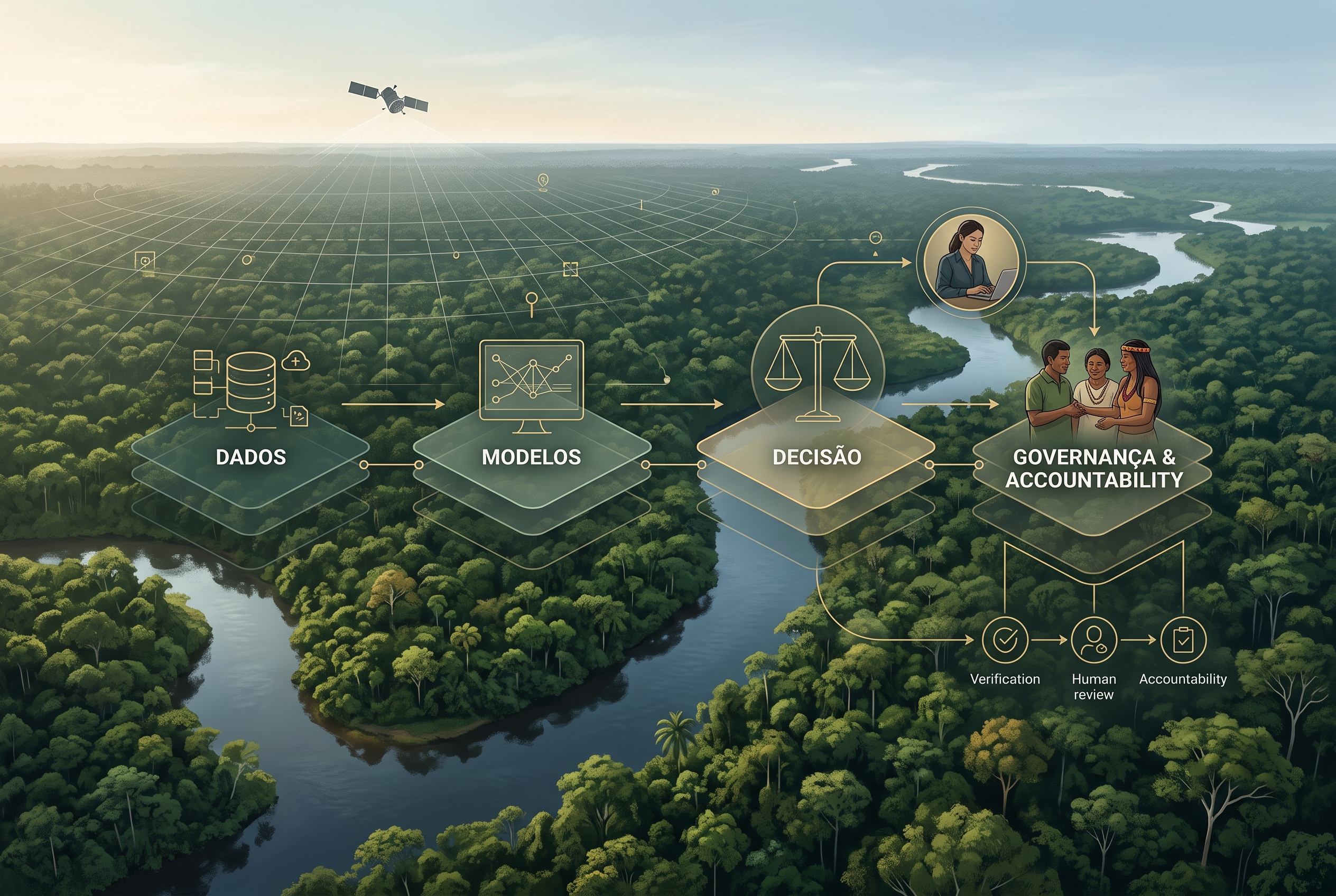
The incorporation of artificial intelligence systems into the environmental governance of the Brazilian Legal Amazon has advanced at a pace that outstrips the production of conceptual frameworks capable of guiding their responsible use, creating a gap between technical capability and institutional accountability that this article seeks to address. The objective was to propose a layered sociotechnical framework and a set of operational safeguards for the use of AI in this domain, organizing existing applications into an analytical typology and mapping the risks associated with each area of use. To this end, an integrative literature review was conducted using Scopus, Web of Science, SciELO, and Google Scholar databases, covering the period from 2015 to 2026, with thematic synthesis organized around four conceptual axes: Data, Models, Decision, and Governance & Accountability. The results comprise a framework structured around these four interdependent layers, a summary matrix correlating applications, risks, safeguards, and monitoring indicators, and an evidence chain representing the flow from automated detection to the corresponding administrative act. It is concluded that the potential of AI in Amazonian environmental governance is real, but strictly contingent on the existence of audit trails, contestation mechanisms, and structured institutional accountability — without which the adoption of these technologies tends to increase the opacity of decision-making processes without producing effective gains in environmental protection.
Downloads
Published
Issue
Section
License
Copyright
Upon acceptance of a manuscript, authors will be asked to complete an "exclusive license" form that will allow the manuscript to be disclosed in the form of open access. In order to do the work of publishing and disseminating the research paper manuscript we need the rights to publish. For open access manuscripts, we use an exclusive licensing agreement where authors retain copyright from their manuscript.
In this agreement the authors retain rights to:
-Patents and other intellectual property rights in manuscript
-The right to credit for published work






