COMPUTATIONAL INTELLIGENCE FOR THE CLASSIFICATION OF ADAPTABILITY AND STABILITY IN COMMON BEAN GENOTYPES
DOI:
https://doi.org/10.36725/agries.v12i1.11711Keywords:
Phaseolus vulgaris L., Genotype-by-environment interactions, XGBoost, Cultivar selectionAbstract
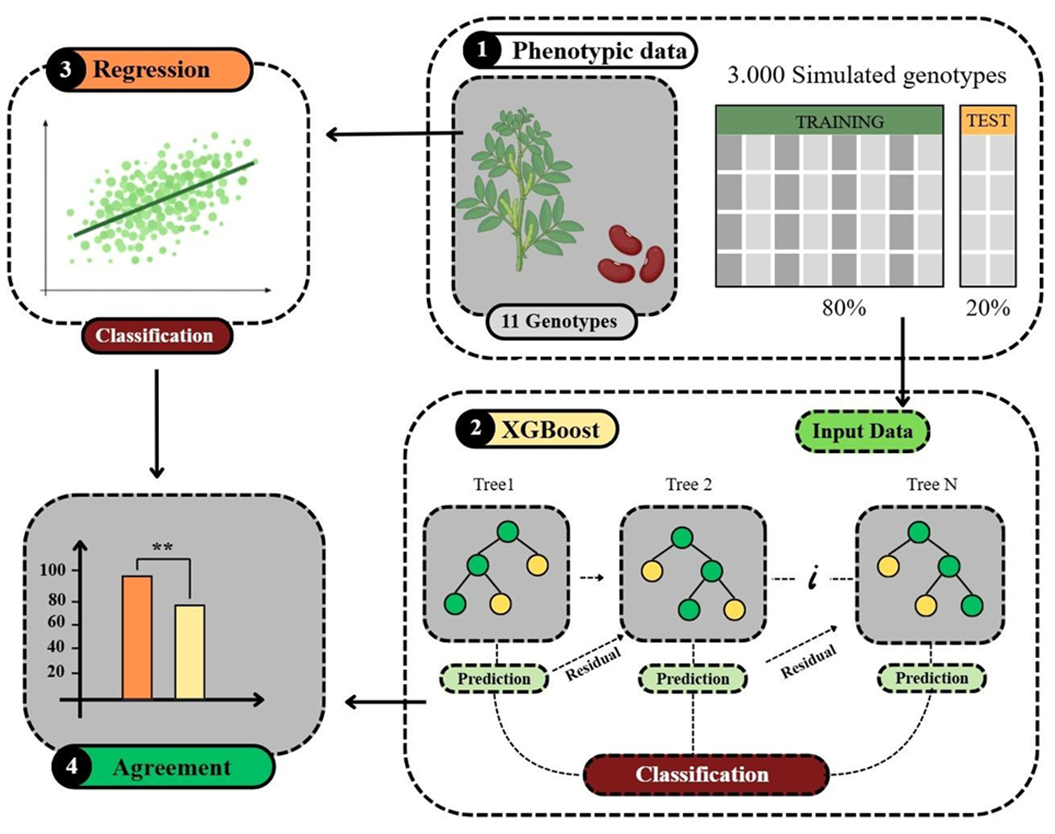
Genotype-by-environment (G×E) interactions complicate the recommendation of common bean (Phaseolus vulgaris L.) varieties. This study aimed to explore the potential of the Extreme Gradient Boosting (XGBoost) machine learning algorithm as a complementary tool for classifying the adaptability and stability of these genotypes in breeding programs. The methodology involved training the XGBoost model with simulated data aligned with the classes proposed by Eberhart and Russell (1966) and Finlay and Wilkinson (1963), followed by the classification of real genotypes. Eleven genotypes were evaluated across 32 environments (combinations of location and year) using a randomized block design. XGBoost showed agreement rates of 100% and 81.82% with the Eberhart and Russell (1966) method for adaptability and stability classifications, respectively. Additionally, the algorithm achieved an accuracy of 89.3%. These results demonstrate the machine learning model's capability to classify genotypes according to established patterns, offering greater analytical flexibility. However, it is crucial to consider that the model's practical applicability and performance are directly linked to the quality and representativeness of the training data. In summary, XGBoost emerges as a promising tool for optimizing adaptability and stability analyses, enhancing breeding efficiency, and improving the precision of cultivar selection.
Downloads
Published
Issue
Section
License
Copyright
Upon acceptance of a manuscript, authors will be asked to complete an "exclusive license" form that will allow the manuscript to be disclosed in the form of open access. In order to do the work of publishing and disseminating the research paper manuscript we need the rights to publish. For open access manuscripts, we use an exclusive licensing agreement where authors retain copyright from their manuscript.
In this agreement the authors retain rights to:
-Patents and other intellectual property rights in manuscript
-The right to credit for published work