BEHAVIORAL PARAMETERS OF BROILER CHICKENS SUBJECTED TO DIFFERENT TYPES OF LITTER AND HOUSING DENSITIES
DOI:
https://doi.org/10.36725/agries.v12i1.11423Keywords:
thermal comfort, ambient temperature, thermographyAbstract
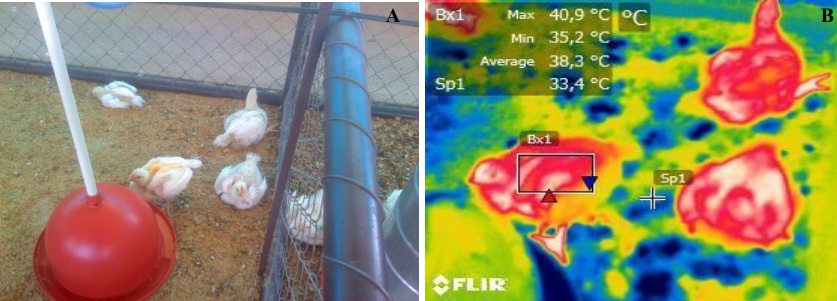
Animal behavior serves as a critical indicator of welfare and thermal comfort in livestock production. In intensive broiler production systems, evaluating behavioral parameters is essential to monitor environmental and management conditions, thereby enhancing productive efficiency and system sustainability. This study aimed to evaluate the behavioral parameters of broiler chickens reared on two litter types at two stocking densities. The experiment was conducted at the Federal University of Northern Tocantins (UFNT), Araguaína, Brazil. A total of 216 one-day-old Cobb 500® broiler chicks of both sexes (average initial weight of $54 \pm 3.37$ g) were distributed in a completely randomized design arranged in a $2 \times 2$ factorial scheme. The treatments consisted of two litter types (wood shavings and rice hulls) and two stocking densities (24 and 30 kg m⁻²), resulting in four treatments with six replicates each. The evaluated behavioral parameters included feeding, drinking, feather pecking, comfort behaviors, dust bathing, scratching, and resting. Additionally, maximum, minimum, and average surface temperatures, as well as thermal amplitude, were analyzed at 21
and 42 days of age. At 21 days of age, dust-bathing behavior was influenced by the 24 kg m⁻² stocking density and rice hull litter. At 42 days, feeding, feather pecking, comfort behaviors, scratching, and resting were significantly affected by both stocking density and litter type. However, broiler surface temperatures at both 21 and 42 days were not influenced by the treatments. In conclusion, the tested litter types and stocking densities alter the behavioral patterns of broiler chickens, modulating their activities without affecting their surface temperatures.
Downloads
Published
Issue
Section
License
Copyright
Upon acceptance of a manuscript, authors will be asked to complete an "exclusive license" form that will allow the manuscript to be disclosed in the form of open access. In order to do the work of publishing and disseminating the research paper manuscript we need the rights to publish. For open access manuscripts, we use an exclusive licensing agreement where authors retain copyright from their manuscript.
In this agreement the authors retain rights to:
-Patents and other intellectual property rights in manuscript
-The right to credit for published work