
ACCELERATED AGING AS A STRESS TEST TO DISCRIMINATE VIGOR IN SORGHUM SEED LOTS
DOI:
https://doi.org/10.36725/agries.v12i1.11404Keywords:
Sorghum bicolor, physiological quality, seed qualityAbstract
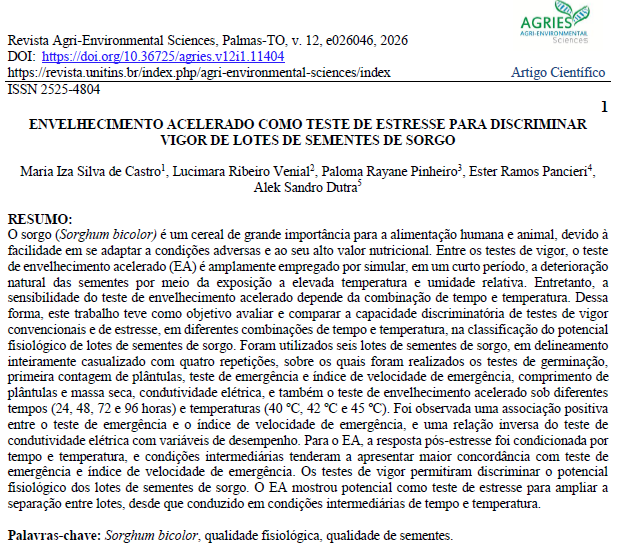
Sorghum (Sorghum bicolor) is a cereal of great importance for human and animal nutrition due to its adaptability to adverse conditions and high nutritional value. Among vigor tests, the accelerated aging (AA) test is widely used because it simulates natural seed deterioration over a short period through exposure to high temperature and relative humidity. However, the sensitivity of the accelerated aging test depends on the combination of time and temperature. Thus, this study aimed to evaluate and compare the discriminatory capacity of conventional and stress vigor tests—using various time and temperature combinations—in classifying the physiological potential of sorghum seed lots. Six sorghum seed lots were used in a completely randomized design with four replicates. The tests performed included germination, first seedling count, emergence and emergence speed index, seedling length and dry mass, electrical conductivity, and accelerated aging under different durations (24, 48, 72, and 96 hours) and temperatures (40°C, 42°C, and 45°C). A positive association was observed between the emergence test and the emergence speed index, while an inverse relationship was found between the electrical conductivity test and performance variables. Regarding AA, the post-stress response was influenced by time and temperature; intermediate conditions tended to show greater agreement with the emergence test and emergence speed index. The vigor tests successfully discriminated the physiological potential of the sorghum seed lots. The AA test demonstrated potential as a stress test to enhance the differentiation between lots, provided it was conducted under intermediate time and temperature conditions.
Downloads
Published
Issue
Section
License
Copyright
Upon acceptance of a manuscript, authors will be asked to complete an "exclusive license" form that will allow the manuscript to be disclosed in the form of open access. In order to do the work of publishing and disseminating the research paper manuscript we need the rights to publish. For open access manuscripts, we use an exclusive licensing agreement where authors retain copyright from their manuscript.
In this agreement the authors retain rights to:
-Patents and other intellectual property rights in manuscript
-The right to credit for published work






