
REACTION OF GENOTYPES FROM THE SOYBEAN QUALITY IMPROVEMENT PROGRAM TO Pratylenchus brachyurus
DOI:
https://doi.org/10.36725/agries.v12i1.11360Keywords:
Glycine Max, nematodes, resistanceAbstract
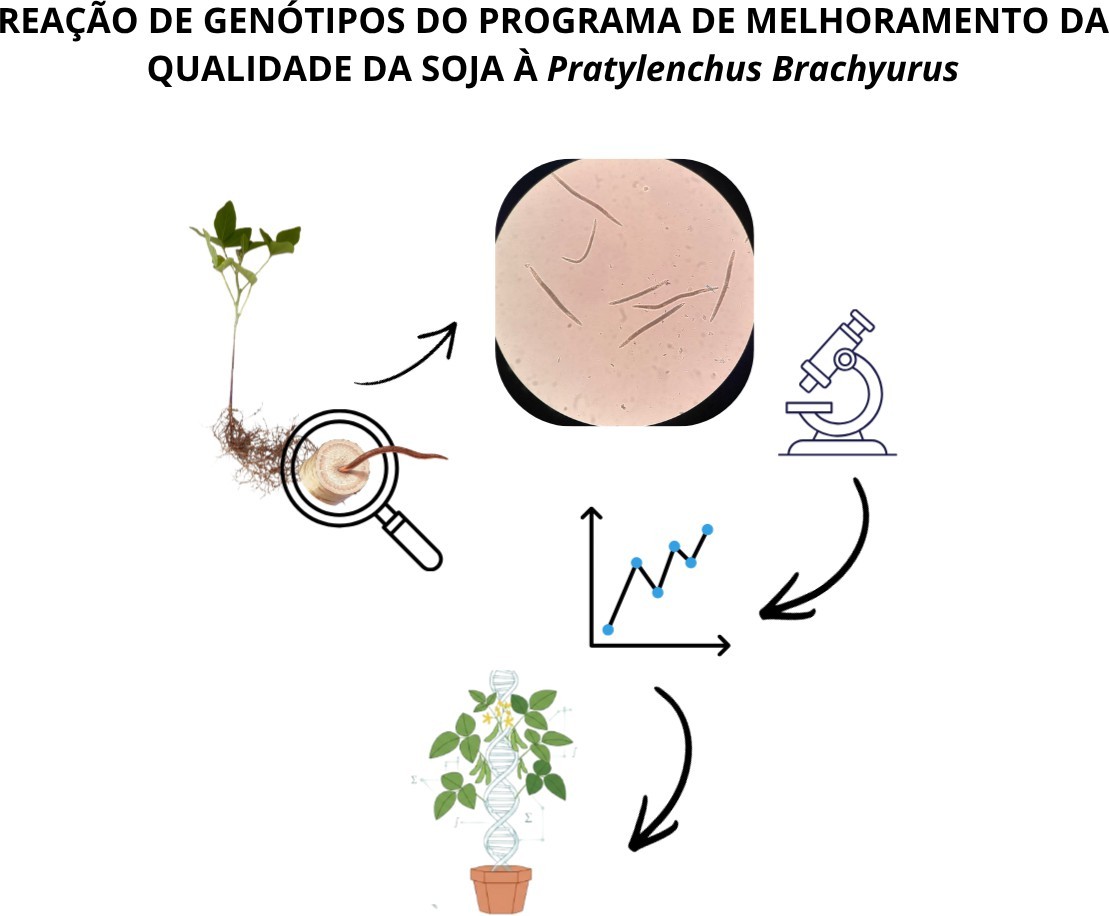
Soybean productivity faces challenges due to parasitism by Pratylenchus brachyurus, which reduces crop performance. One of the main obstacles in breeding programs is finding genotypes resistant to this pathogen, as no soybean varieties with such resistance have yet been identified. This study evaluated 10 soybean lines from the breeding program of the Institute of Applied Biotechnology to Agriculture (BIOAGRO/FV) for resistance to P. brachyurus, in addition to the cultivars CD213PTA, M7739, N7901, and DESAFIO, the parents of the lines. The experiment was conducted in a greenhouse under a completely randomized design with six replications. Two weeks after sowing in substrate, the seedlings were transplanted into polyethylene pots containing 0.5 dm³ of autoclaved soil. The inoculation of nematodes was carried out by making two holes in the soil beside each plant, into which 4 mL of an inoculum suspension were applied per hole, totaling 8 mL of suspension containing 1000 individuals of P. brachyurus per experimental unit. After 70 days, the root system of each plant was processed separately. The number of P. brachyurus individuals per treatment was quantified in a Peters chamber, and the number of nematodes per root was measured and subsequently used to calculate the reproduction factor (FR) and nematodes per gram (N g-1) of root for each treatment. The results were subjected to the Scott-Knott test at a 5% probability level. None of the evaluated soybean genotypes were resistant to P. brachyurus (FR < 1); however, the cultivar CD213PTA was able to reduce nematode multiplication, differing statistically from the other genotypes and can therefore be recommended for breeding programs aimed at developing varieties tolerant to the root-lesion nematode.
Downloads
Published
Issue
Section
License
Copyright
Upon acceptance of a manuscript, authors will be asked to complete an "exclusive license" form that will allow the manuscript to be disclosed in the form of open access. In order to do the work of publishing and disseminating the research paper manuscript we need the rights to publish. For open access manuscripts, we use an exclusive licensing agreement where authors retain copyright from their manuscript.
In this agreement the authors retain rights to:
-Patents and other intellectual property rights in manuscript
-The right to credit for published work






