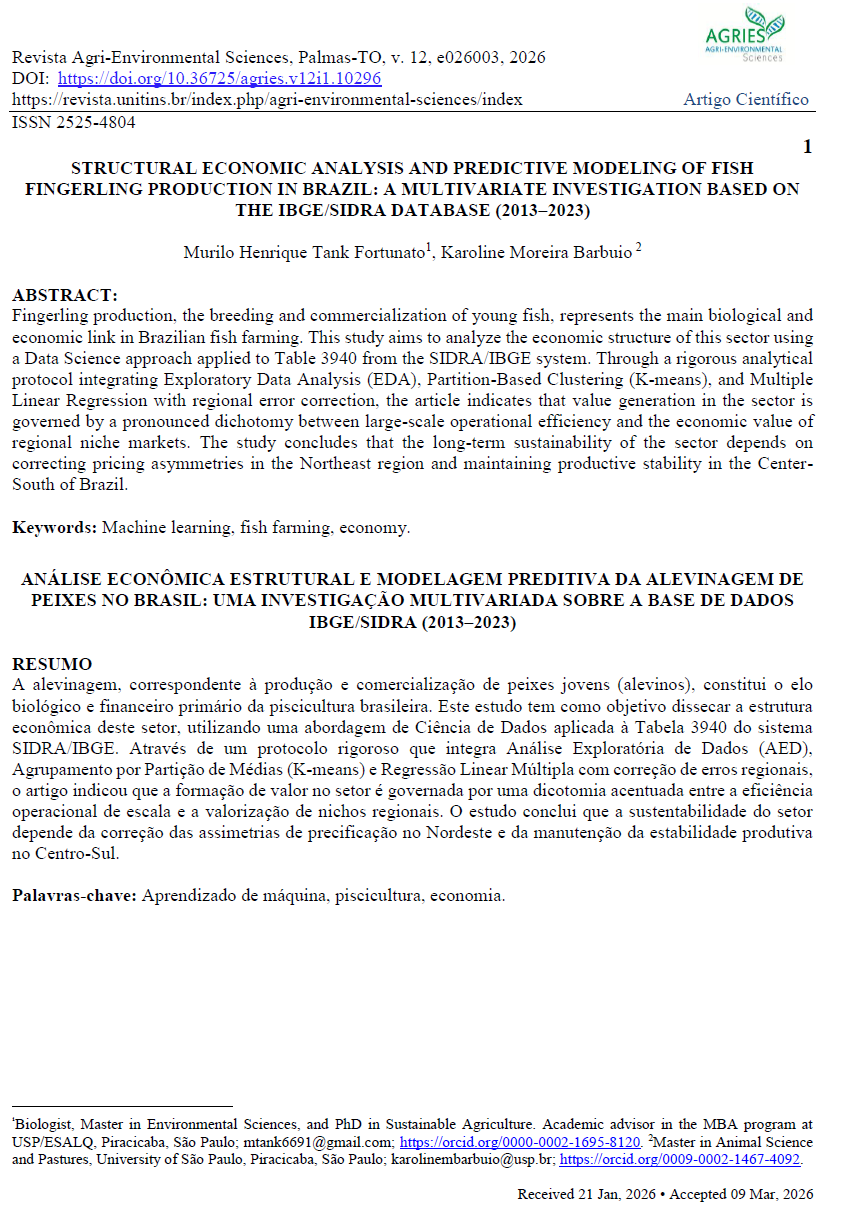
STRUCTURAL ECONOMIC ANALYSIS AND PREDICTIVE MODELING OF FISH FINGERLING PRODUCTION IN BRAZIL: A MULTIVARIATE INVESTIGATION BASED ON THE IBGE/SIDRA DATABASE (2013–2023)
DOI:
https://doi.org/10.36725/agries.v12i1.11296Keywords:
Machine learning, Fish farming, EconomyAbstract
Fingerling production, the breeding and commercialization of young fish, constitutes the primary biological and financial link in Brazilian fish farming. This study aims to dissect the economic structure of this sector using a Data Science approach applied to Table 3940 from the SIDRA/IBGE system. Through a rigorous analytical protocol integrating Exploratory Data Analysis (EDA), Partition-Based Clustering (K-means), and Multiple Linear Regression with regional error correction, the article demonstrates that value formation in the sector is governed by a pronounced dichotomy between large-scale operational efficiency and the economic valuation of regional niche markets. The study concludes that the long-term sustainability of the sector depends on correcting pricing asymmetries in the Northeast region and maintaining productive stability in the Center-South of Brazil.
Downloads
Published
Issue
Section
License
Copyright
Upon acceptance of a manuscript, authors will be asked to complete an "exclusive license" form that will allow the manuscript to be disclosed in the form of open access. In order to do the work of publishing and disseminating the research paper manuscript we need the rights to publish. For open access manuscripts, we use an exclusive licensing agreement where authors retain copyright from their manuscript.
In this agreement the authors retain rights to:
-Patents and other intellectual property rights in manuscript
-The right to credit for published work