CHARACTERIZATION, AGRICULTURAL APTITUDE AND USE CAPACITY OF ‘PLANOSSOLO HÁPLICO’: A CASE STUDY IN FIRMINO ALVES -BA.
A CASE STUDY IN FIRMINO ALVES -BA.
DOI:
https://doi.org/10.36725/agries.v11i1.10277Keywords:
Soil classification, Soil genesis, Sustainable useAbstract
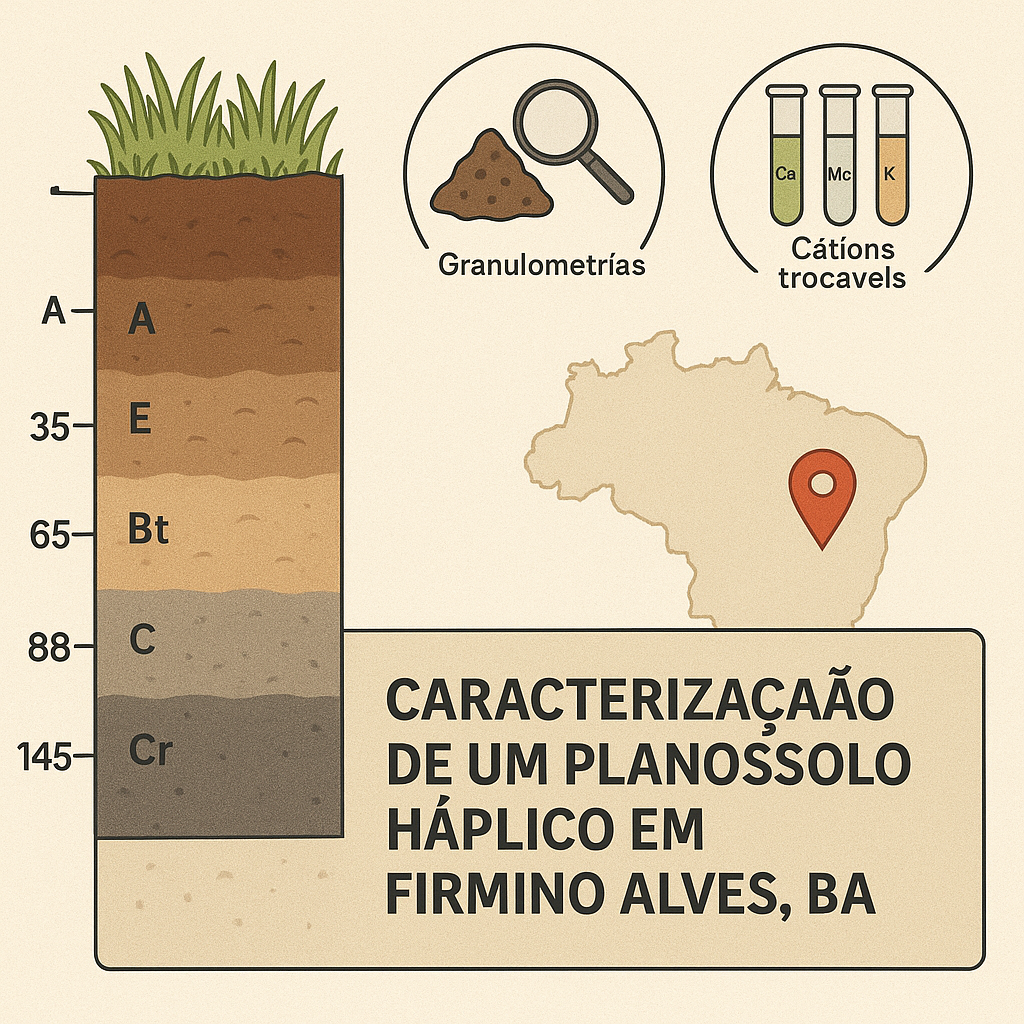
The present study centered on the comprehensive characterization of a Planossolo Háplico situated within the municipality of Firmino Alves, Bahia. The objective of this study was to contribute to the comprehension of the agricultural challenges experienced by the region, with a particular focus on soils that exhibit imperfect
drainage and a high degree of susceptibility to salinization. The objectives of the study included analyzing the
morphological, physical, and chemical characteristics of the soil, as well as evaluating its agricultural
suitability and land use capacity. The methodology entailed the collection of soil samples along the profile,
followed by routine laboratory analyses. The analyses encompassed a range of parameters, including but not
limited to: particle size distribution, water-dispersible clay, degree of flocculation, silt/clay ratio, as well as pH, exchangeable cations, cation exchange capacity, and base saturation. The soil profile displays a diverse
texture, predominantly sandy loam, accompanied by variations in clay and sandy clay loam. The color of the
horizons also varies, reflecting differences in permeability and organic content. A chemical analysis of the soil
reveals that, despite its acidic nature, the exchange complex is saturated with basic cations. The ratio of calcium to magnesium (Ca:Mg) exhibits a decline with depth, which has the potential to influence nutrient availability. The agricultural suitability assessment classified the soil into groups with different degrees of limitation for crops, pastures, and other uses. An evaluation revealed that the land's utilization potential was constrained due to inherent soil properties. The Planossolo Háplico Eutrófico solódico in the study area presents characteristics that limit its agricultural use, primarily due to low permeability and the risk of salinization. In order to ensure the viability of livestock farming and other agricultural practices in the region, it is imperative to implement specific management strategies that take these constraints into account. The research underscores the necessity for additional studies to develop management strategies that can mitigate the challenges associated with these soils, ensuring soil quality preservation and maintaining agricultural productivity.
Downloads
Published
Issue
Section
License
Copyright
Upon acceptance of a manuscript, authors will be asked to complete an "exclusive license" form that will allow the manuscript to be disclosed in the form of open access. In order to do the work of publishing and disseminating the research paper manuscript we need the rights to publish. For open access manuscripts, we use an exclusive licensing agreement where authors retain copyright from their manuscript.
In this agreement the authors retain rights to:
-Patents and other intellectual property rights in manuscript
-The right to credit for published work