HOW MULTILAYER PERCEPTRON ARCHITECTURE AND TRAINING HYPERPARAMETERS AFFECT PREDICTIVE PERFORMANCE IN UAV-BASED SOYBEAN PHENOTYPING
DOI:
https://doi.org/10.36725/agries.v12i3.12148Keywords:
artificial neural networks, high-throughput phenotyping, multispectral imagery, vegetation indices, remote sensingAbstract
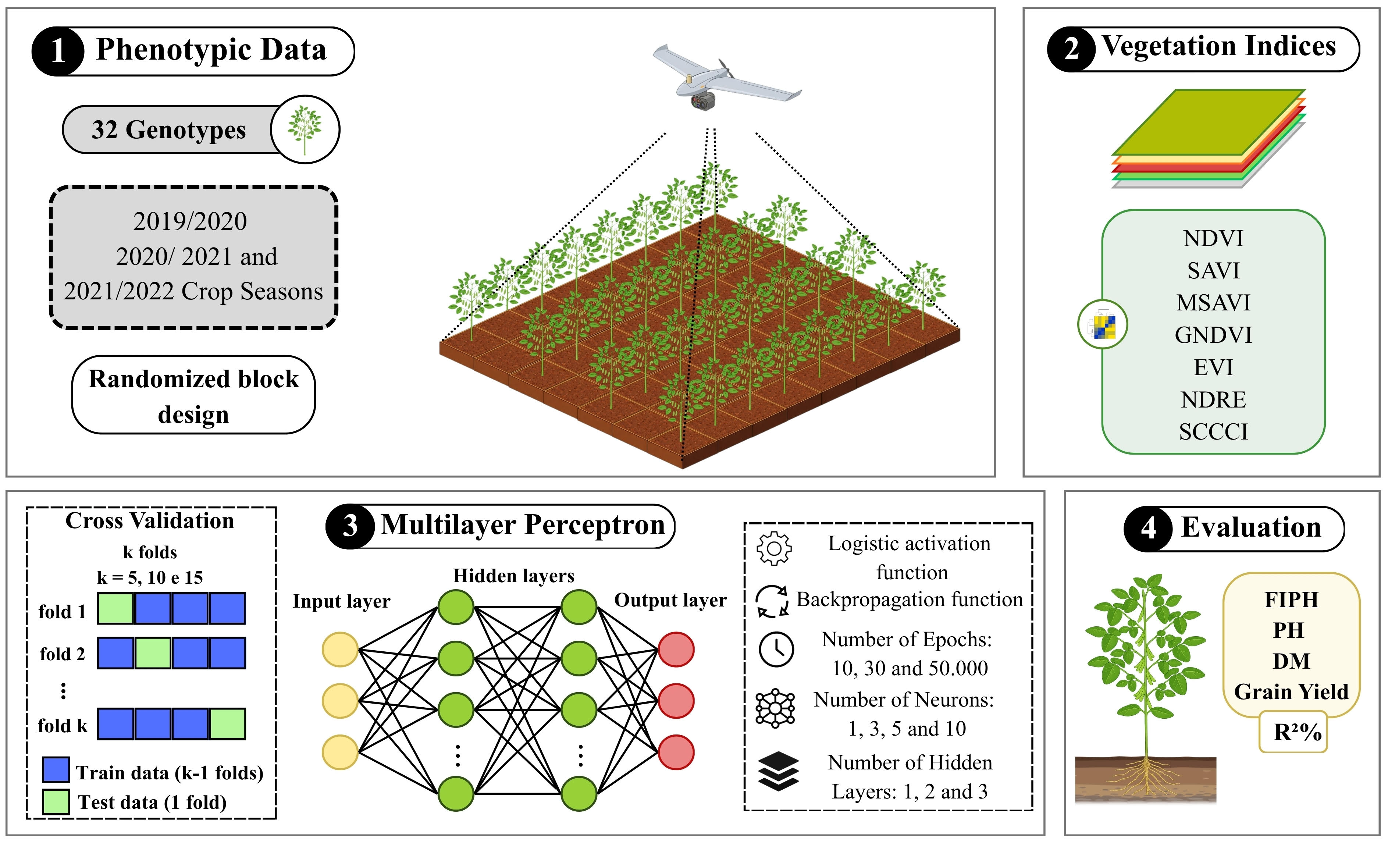
Multilayer perceptron (MLP) models have been increasingly applied to high-throughput phenotyping using unmanned aerial vehicle (UAV)-derived multispectral imagery. However, the effects of network architecture and training hyperparameters on predictive performance remain poorly understood. This study evaluated the number of neurons, hidden layers, training epochs, and cross-validation folds, as well as the performance of different combinations of these factors in MLP models to predict soybean phenotypic traits using vegetation indices. A total of 32 soybean genotypes were evaluated over three growing seasons, generating 384 experimental plots. Seven vegetation indices derived from UAV-based multispectral imagery were used to predict plant height (PH), first pod insertion height (FPIH), days to maturity (DM), and grain yield (GY). Under the conditions evaluated, increasing network width improved predictive performance up to a plateau, whereas additional hidden layers provided no consistent advantage. Likewise, under the conditions studied, extending training from 10,000 to 30,000 epochs improved prediction accuracy, but further increases produced only marginal gains. Models evaluated using 15-fold cross-validation consistently achieved the highest predictive performance. The effects of architectural and training parameters also depended on the biological nature of the target trait, with PH and FPIH showing higher predictive performance than DM and GY. Overall, the results demonstrate that optimizing architecture and training parameters can improve model performance, but the extent of this improvement depends on the ability of vegetation indices to represent the target phenotypic trait. These findings provide practical guidance for configuring MLP models in UAV-based high-throughput soybean phenotyping.
Downloads
Published
Issue
Section
License
Copyright
Upon acceptance of a manuscript, authors will be asked to complete an "exclusive license" form that will allow the manuscript to be disclosed in the form of open access. In order to do the work of publishing and disseminating the research paper manuscript we need the rights to publish. For open access manuscripts, we use an exclusive licensing agreement where authors retain copyright from their manuscript.
In this agreement the authors retain rights to:
-Patents and other intellectual property rights in manuscript
-The right to credit for published work