ANTIBACTERIAL POTENTIAL OF Xylopia aromatica, Allium cepa E Allium sativum EXTRACTS IN THE CONTROL OF WAXY SPOT (Pseudomonas cichorii) IN LETTUCE
DOI:
https://doi.org/10.36725/agries.v12i3.12092Keywords:
Annonaceae, biphasic response, plant extracts, varnish spotAbstract
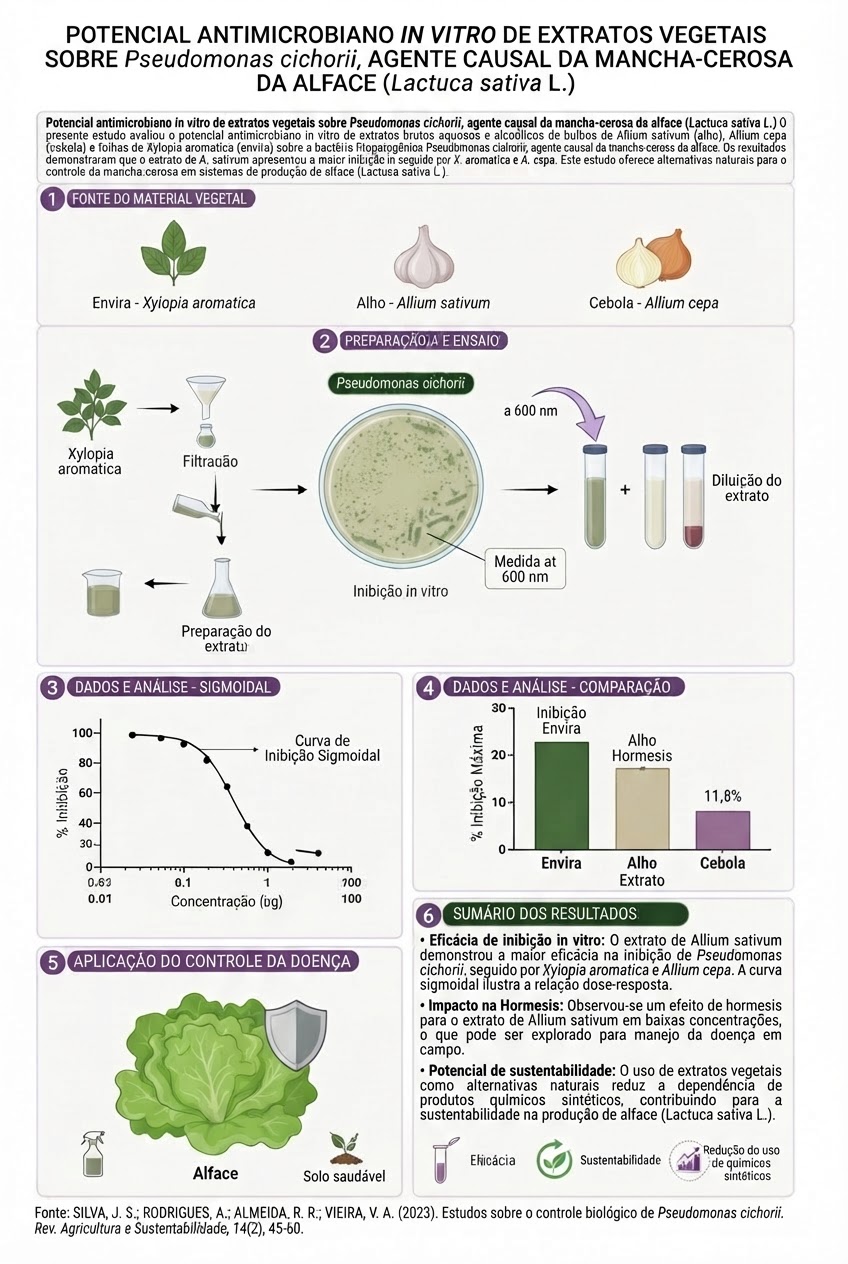
This study evaluated the in vitro antimicrobial potential of aqueous extracts of Envira, garlic, and onion against the growth of Pseudomonas cichorii, the causal agent of bacterial blight of lettuce (Lactuca sativa L.). The experimental design was completely randomized, in a 3 × 8 factorial scheme (three extracts and eight concentrations: 0, 100, 200, 500, 1,000, 2,000, 5,000, and 10,000 mg L⁻¹), with four replications. Bacterial growth was estimated by turbidimetry at 600 nm after 24 h of incubation at 28 °C. The Envira extract exhibited the most favorable profile, showing dose-dependent inhibition, absence of growth stimulation at all tested concentrations, and an inhibition plateau from 2,000 mg L⁻¹ onward, with no statistical difference among 2,000, 5,000, and 10,000 mg L⁻¹. The garlic extract achieved the highest inhibition observed, but displayed a biphasic response consistent with possible hormesis, with growth stimulation of 11.0% and 5.1% at 100 and 200 mg L⁻¹, respectively. The onion extract showed the poorest performance, with a maximum inhibition of only 11.8% at 10,000 mg L⁻¹. None of the extracts reached 50% inhibition within the evaluated range; therefore, the EC₅₀ was not determined. The half-response parameter of the four-parameter log-logistic model corresponds to inhibitions of approximately 21% to 24%, and the interpolated EC₂₅ values were approximately 1,470 and 1,810 mg L⁻¹, respectively. Analysis of variance indicated significant effects of extract, concentration, and their interaction (p < 0.0001), with concentration accounting for 64.7% of the total variation, the interaction for 25.3%, and the extract for 8.6%, with R² values ranging from 0.60 to 0.92. It is concluded that the Envira extract is the most promising candidate for further investigation in disease control, followed by garlic, whereas onion showed low potential.
Downloads
Published
Issue
Section
License
Copyright
Upon acceptance of a manuscript, authors will be asked to complete an "exclusive license" form that will allow the manuscript to be disclosed in the form of open access. In order to do the work of publishing and disseminating the research paper manuscript we need the rights to publish. For open access manuscripts, we use an exclusive licensing agreement where authors retain copyright from their manuscript.
In this agreement the authors retain rights to:
-Patents and other intellectual property rights in manuscript
-The right to credit for published work