FERMENTATIVEPROCESS EVALUATION OF MEAD USING KEFIR AND ENCAPSULATEDYEASTS
DOI:
https://doi.org/10.36725/vcx4dx15Keywords:
Alcoholic fermentation, Cell immobilization, Fermentation kineticsAbstract
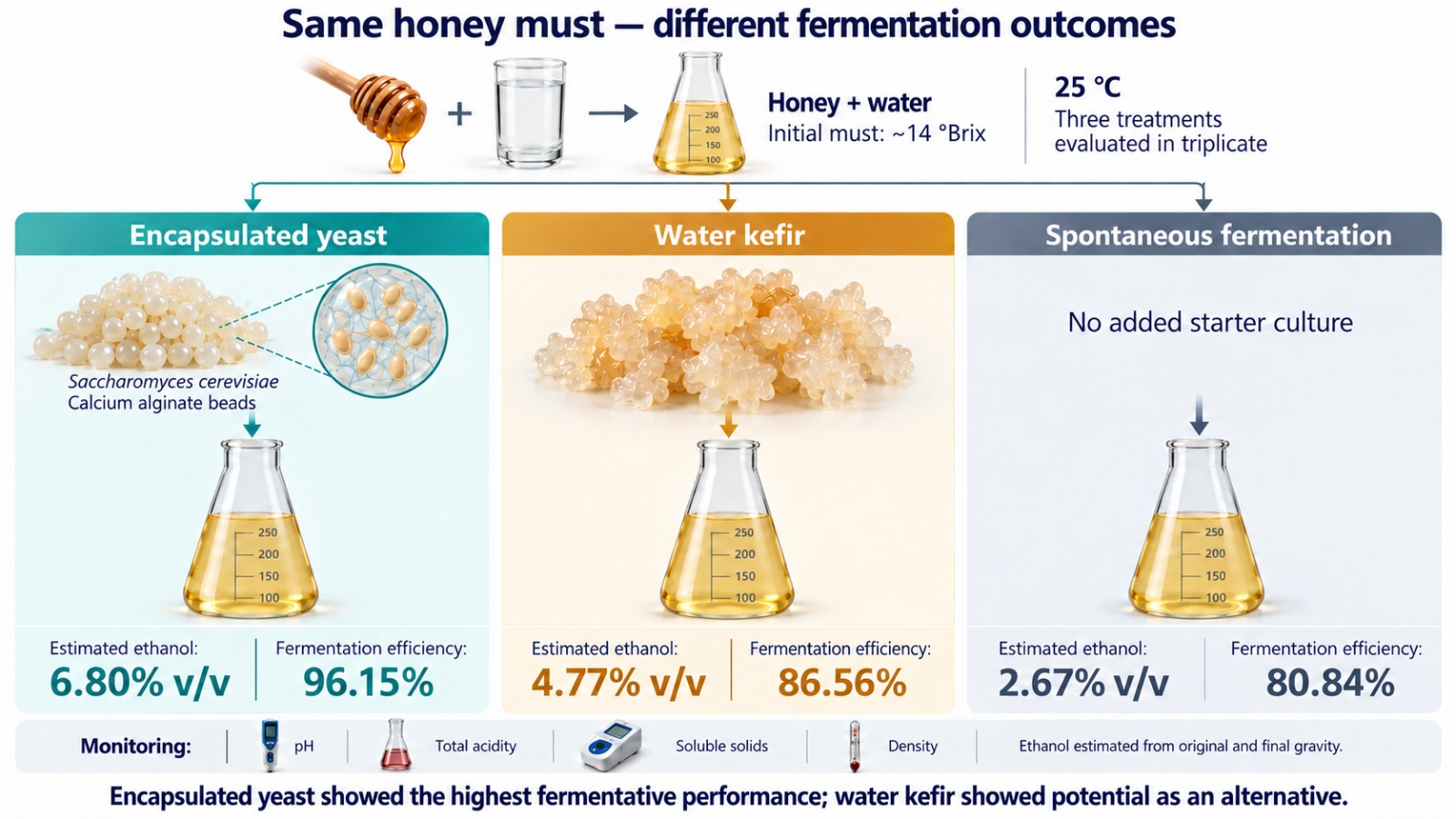
Mead is an alcoholic beverage obtained from the fermentation of water and honey, traditionally carried out using pure cultures of unicellular yeasts of the genus Saccharomyces. Alternatively, the cell immobilization
process can be used to encapsulate microorganisms in a support materia l. A similar system occurs in kefir grains. These grains are composed of a polysaccharide matrix that brings together a variety of microbiota with fermentative capacity. This study aimed to monitor mead ferm entation using three treatments encapsulated yeas t, water kefir, and spo ntaneous fermentation ( and to evaluate their kinetic and physicochemical parameters. Similar pH and total acidity values were found for all treatments. A significant difference was found for density and total soluble solids analyses, with greater emphasis on the use of yeast, followed by kefir and, finally, the control treatment. Regarding the kinetic parameters, the encapsulated yeast treatment showed the highes t productivity (0.202 mL/100 mL h), fermentation yield ( and efficiency ( fol lowed by kefir (0.064 mL/100 mL h, 44.22%, and 86.56%, respectively) and the con trol treatment (0.041 mL/100 mL h, 41.31%, and 80.84%, respectively). The final ethanol contents were 6.80% v/v for the encapsulated yeast treatmen t, 4.77% v/v for kefir, and 2.67% v/v for the control. The results demonstrated the feasibility of using encapsulated yeast and water kefir as
Downloads
Published
Issue
Section
License
Copyright (c) 2026 AGRI-ENVIRONMENTAL SCIENCES

This work is licensed under a Creative Commons Attribution-NonCommercial-NoDerivatives 4.0 International License.
Copyright
Upon acceptance of a manuscript, authors will be asked to complete an "exclusive license" form that will allow the manuscript to be disclosed in the form of open access. In order to do the work of publishing and disseminating the research paper manuscript we need the rights to publish. For open access manuscripts, we use an exclusive licensing agreement where authors retain copyright from their manuscript.
In this agreement the authors retain rights to:
-Patents and other intellectual property rights in manuscript
-The right to credit for published work