PHYTOSOCIOLOGICAL SURVEY AS A TOOL FOR CHEMICAL MANAGEMENT IN CASSAVA CROP IN MUNDO NOVO, MS, BRAZIL
DOI:
https://doi.org/10.36725/agries.v12i2.11541Keywords:
Weed control, Weed infestation, Weed competition, Manihot esculenta, WeedsAbstract
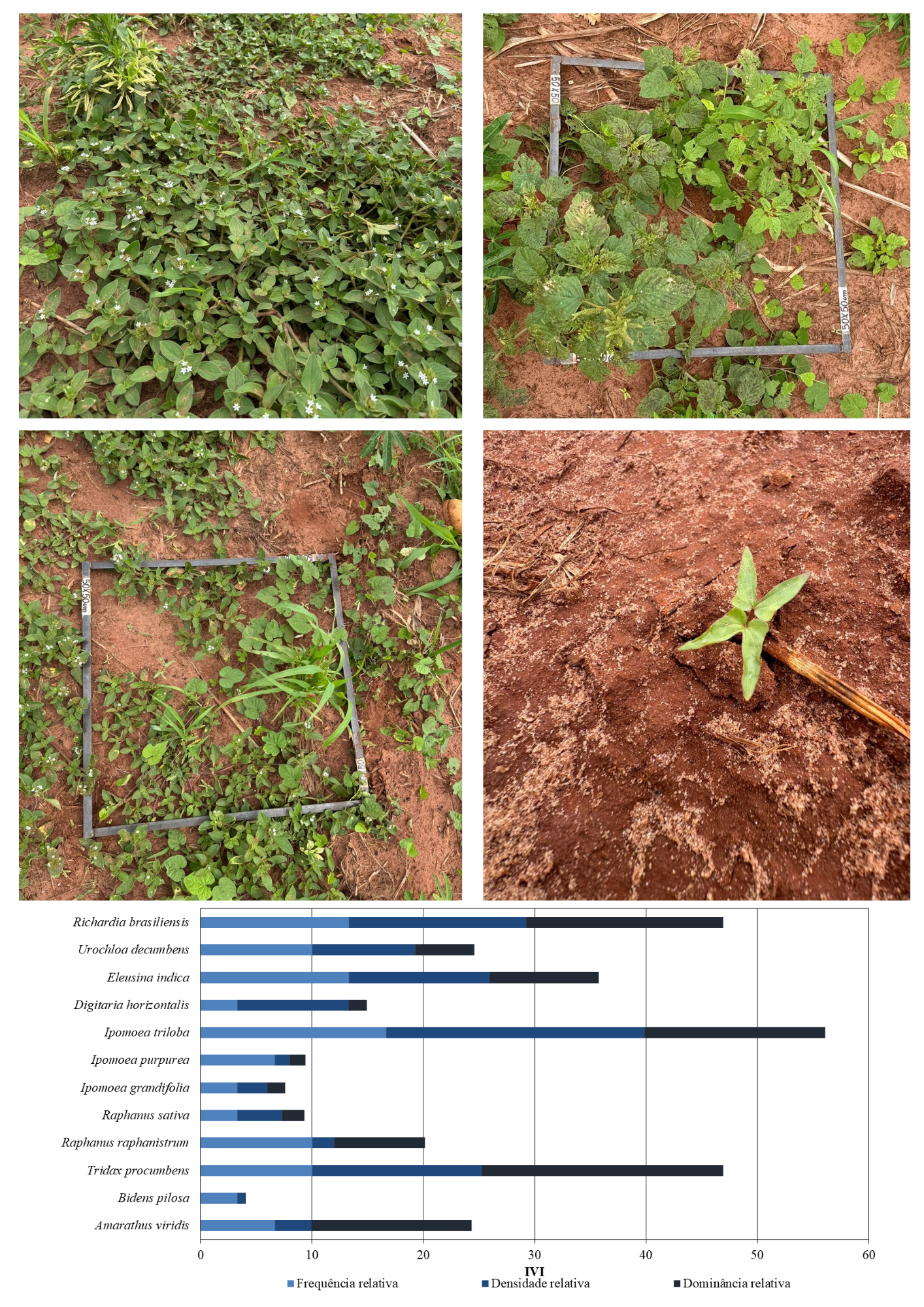
Cassava production can be severely affected by weed occurrence and competition, which increase production costs and hinder other management practices. This study aimed to conduct a phytosociological survey of weeds in a cassava cultivation area in Mundo Novo, Mato Grosso do Sul, Brazil, in order to generate information to support the development of weed management programs for cassava. Weed communities were assessed using the quadrat sampling method, with ten random placements in the study area. All plants within each quadrat were identified, quantified by species, and their dry mass was determined. The data were analyzed using descriptive statistics, and phytosociological parameters, including relative frequency, relative density, relative dominance, and importance value index (IVI), were calculated, along with dry mass. Based on these results, weed management strategies were developed for cassava cultivation. A total of 12 species belonging to six families were identified, with a predominance of eudicots. The species with the highest importance value index were Ipomoea triloba, Tridax procumbens, and Richardia brasiliensis. The proposed management strategy is based on the sequential use of herbicides registered for cassava, starting with pre-planting desiccation, followed by pre-emergence and post-emergence applications (directed spraying or manual application). It is concluded that the phytosociological survey effectively identified the main weed species, highlighting I. triloba, T. procumbens, and R. brasiliensis due to their high importance value index and competitive potential. An efficient chemical management strategy integrates phytosociological diagnosis with the use of herbicides registered for cassava.
Downloads
Published
Issue
Section
License
Copyright
Upon acceptance of a manuscript, authors will be asked to complete an "exclusive license" form that will allow the manuscript to be disclosed in the form of open access. In order to do the work of publishing and disseminating the research paper manuscript we need the rights to publish. For open access manuscripts, we use an exclusive licensing agreement where authors retain copyright from their manuscript.
In this agreement the authors retain rights to:
-Patents and other intellectual property rights in manuscript
-The right to credit for published work