Colletotrichum truncatum (Schwein.) Andrus & W.D. Moore IN SOYBEAN SEEDS: OCCURRENCE, PATHOGENICITY, AND ANTAGONISTIC POTENTIAL OF Bacillus spp.
DOI:
https://doi.org/10.36725/agries.v12i3.12050Palabras clave:
Biological control, Seed health, AnthracnoseResumen
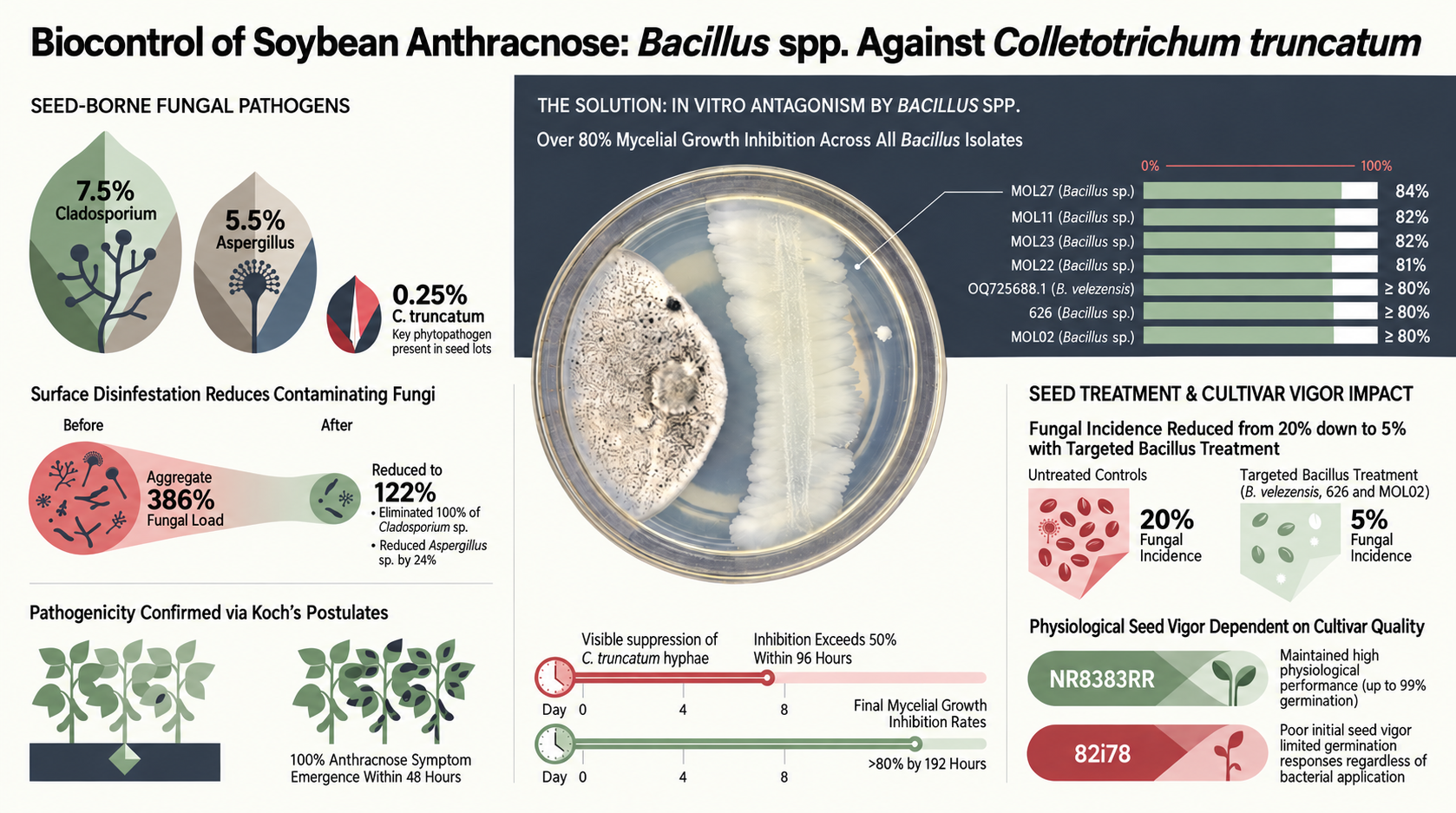
Soybean (Glycine max (L.) Merr.) is an important global crop that is often affected by phytopathogenic fungi. These fungi compromise seed germination and early seedling development, resulting in significant yield losses. This study examined the fungi naturally associated with soybean seeds, the physiological performance of various seed lots, the impact of Bacillus spp. treatments on the incidence of fungi associated with seeds and seed germination, and the ability of Bacillus isolates to antagonize Colletotrichum truncatum. Four soybean cultivars (OLIMPO, 82i78, NR8383RR, and SYN16871PRO) were evaluated using assays of seed health, germination, emergence, pathogenicity, seed treatment, and in vitro antagonism. The most prevalent fungi identified were Aspergillus sp. (5.5%), Cladosporium sp. (7.5%), and Colletotrichum truncatum (0.25%). The pathogenicity of the C. truncatum isolate was confirmed by symptom development and subsequent re-isolation of the pathogen from inoculated plants. However, cultivar 82i78 could not be evaluated due to the absence of plant development. The incidence of fungi associated with seeds and germination varied depending on the treatment with Bacillus species, cultivar, and surface disinfection conditions. In vitro confrontation assays demonstrated strong antagonistic activity against C. truncatum. All Bacillus isolates showed high mycelial growth inhibition, and isolate MOL27 (Bacillus sp.) reached the highest inhibition value (84%). Overall, these results demonstrate that Bacillus spp. can influence the incidence of fungi naturally associated with soybean seeds and exhibit strong antagonistic activity against C. truncatum in vitro. This supports further investigation of these isolates as potential biological control agents.
Descargas
Publicado
Número
Sección
Licencia
Direitos autorais
Após a aceitação de um artigo, os autores serão convidados a preencher um formulário de " licença exclusiva” que permitirá a divulgação do artigo na forma de acesso aberto. Para podermos fazer o trabalho de publicação e divulgação do artigo de pesquisa precisamos dos direitos para publicação. Para artigos de acesso aberto, usamos um acordo exclusivo de licenciamento em que os autores mantêm os direitos autorais em/de seu artigo.
Neste acordo os autores mantêm direitos sobre:
-Patentes e outros direitos de propriedade intelectual no artigo
-O direito de crédito para o trabalho publicado
Política de Acesso
Os artigos pulicados nesta revista são de acesso aberto, devem ser compartilhados livremente desde que a fonte e seus autores sejam citados de maneira adequada, visando à preservação dos direitos autorais e propriedade intelectual. Os trabalhos publicados na revista serão simultaneamente licenciados sob a Creative Commons Attribution License (CC BY-NC-ND), permitindo o compartilhamento do artigo com reconhecimento da autoria do trabalho e da publicação inicial nesta revista.